Pastor Hurst
Head Pastor (1991-2024)Pastor Clifford Hurst has been in the ministry since 1979. He has served, often concurrently, as youth leader, evangelist, Bible school instructor, principal, instructor, and administrator of Christian schools, leader of Pentecostal associations, and, since 1992, as pastor of the Union Pentecostal Church. He has earned a bachelors degree in Bible with a minor in Greek and a masters degree in Bible literature with Old Testament emphasis. In 1984 he married Sandra who shares in the ministry with him. They have four children and nine grandchildren.
Articles
Jan 9, 2022
·Pastor Hurst
IT’S NOT THE DIVISION; IT’S WHAT’S BETWEEN THE TWO
Decades ago, a pastor encountering opposition, during a service, had all the folks who supported him to stand and those who didn’t to remain seated. It was an awkward silence as about half were standing and half were seated. Someone spoke up with a broken voice, “Pastor, you’ve just divided the church. You’ve divided families. You’ve divided homes.” Our nation's president has stood before us and divided us. He has divided nation, families, friends… He has divided us into two--the vaccinated and the unvaccinated. He did not just factually reference the division. He in tone, connotation, intent, and direct attack vitriolically and caustically with scolding voice designated the unvaccinated as villainous, ignorant, wicked. He didn’t just note that there is group A and group B. He said that group A was holy and good and that group B was unholy and evil. He did it in such a way, he put animosity, enmity, between the two groups. This, I do not bring up to rebuke the president nor to enter the fray over vaccine efficacy or government intrusion. I just could not escape an overwhelming awareness that our president is correct. There really are but two groups. And I am not referring to the vaccinated and unvaccinated. The whole dividing us into the vaccinated/unvaccinated debacle only reveals once again humanity’s default hypocrisy. You, I’m sure, have noticed how quickly politicians can change their views dependent on whether or not their party is in power. For example, when Republicans are in power, they inveigh against the filibuster and the Democrats praise it. When Democrats are in power, they inveigh against the filibuster and the Republicans praise it. Well, you know the thing. That’s something that occurred to me about this dividing the nation over the vaccination. Here are liberals, who, prior to CRT influences, were preaching we shouldn’t divide people into two groups like citizens and illegal immigrants, now dividing us into two groups. And then the conservatives, who normally preach we should divide between groups such as citizens and illegal immigrants, decrying that we are being divided between vaccinated and unvaccinated. Wherever one may stand on any issue of dividing folks into groups, the truth is all of humanity IS divided into two groups: Those who have eternal life and those who perish. Perhaps the most loved and familiar verse of the Bible, John 3:16, delineates this division: “For God so loved the world that He gave His only begotten Son that whosoever believeth in Him should not perish but have everlasting life.” Yes, there are only two groups. There is no neutral, middle road, third or fourth. Just two. Those who have eternal life and those that perish. Heaven bound. Hellbound. How sobering. Declaring the division is not itself divisive. It is how it is declared. First, no one who truly is in the category of those who have eternal life arrogantly and disdainfully ridicules those who perish—as the administration’s vaccinated have ridiculed the unvaccinated. They are not smug and prideful about belonging to the group that has eternal life. They are only grateful. Second, those who believe they are in the group possessing eternal life proclaim the division without trying to create animus between the groups. Yes, Jesus said the world would hate his disciples. But He did not say His disciples should hate the world back or try to get fellow disciples to hate the world. This is the real wrong of our president’s approach. He did not just note the two-group division of vaccinated and unvaccinated. He did so in a way to create animus and antipathy of the vaccinated for the unvaccinated. He blamed the unvaccinated for killing folks. How could that not create animus? He sainted the vaccinated and villainized the unvaccinated. No, those with eternal life only desire that those who perish would come to know Jesus and the eternal life, abundant life, He gives. God does not hate those that perish. He loves them. And the eternal life crowd does too. There are many other differences between the administration’s dividing between the vaccinated and unvaccinated and Christ followers dividing between those with eternal life and those who perish, but let me note one more: Unlike this administration’s machinations, those with eternal life do not try to coerce those who perish to convert. True believers would quickly and roundly condemn history’s Crusaders and Conquistadors who sought to force conversion by spear point. Belief in Jesus is a choice. We who belong to those with eternal life may seek to persuade, convince, and even plead, but, we do not try to force. Yes, there ARE only two groups. Rigidly so. Those with eternal life and those who perish. But we must not hate those that perish. We must have love and compassion for them. Any animus we have must be reserved for the one who deceives them, enslaves them, and seeks to keep them in his group, the group of those that perish. Whether or not folks should even be divided into two groups can divide folks into two groups: those who believe we should be divided into two and those who don’t. I can hear the cries of the pluralists screaming at we believers the charge of exclusivity. But, in their protestations, even they divide everyone between the pluralistic and the exclusivistic. Ironically, cries for not dividing only accentuate that there is a division. It is impossible not to divide between groups. What matters is what exists between the two. Jesus occupied the center cross, dividing between a believer and an unbeliever. The cross always divides between those two. Yet, at Calvary, there was no animus between the believer and unbeliever. Only Christ. He did not try to create antipathy between those two who were headed for two completely different destinations—Paradise and Gehenna. Between them, He only demonstrated love in the most painful and vividly graphic of ways. It’s not the division; it’s what’s between the two. --Pastor Clifford Hurst
Jan 2, 2022
·Pastor Hurst
DON’T LET CAN’T KEEP YOU FROM CAN
Writing this gives me the opportunity to trumpet about getting the latest Apple Watch as a gift for Christmas. One of its main features is the Fitness app. To try it out, one of my sons-in-law and I took a walk. Our conversation turned to how folks will with great anticipation, eagerness, and a good dose of bluster begin an exercise regime only to soon get discouraged and quit it. One of the reasons they get discouraged is that they have something get them off their exercise schedule, and they never get restarted. Walking is one of the few times I am talkative--not to myself, but on the phone or while walking with someone. I found myself blabbering on about an axiom I formulated to help me stick with something. This is the New Year and the time many begin new commitments to exercise, diet, hobby, renew church/worship involvement, begin spiritual disciplines, etc. I thought I’d share my axiom. It may be of no benefit to anyone else, but through many years it has helped me. Even recently, it assisted my getting back on track with something. It has also kept me on track with many other things. What is it? Simply this: “Don’t let when you can’t keep you from when you can.” People begin, let’s say, an exercise regimen. No, we’ll use that later. Let’s say a diet—though that’s a more dangerous illustration. The prospective dieter researches different diets, visits the grocery store for health items, studies nutrition charts, figures BMI goals, calculates calories to be consumed, cleans out the cupboards and refrigerators of junk food to eliminate temptation, makes a daily menu, etc. With the new year’s commencement, he begins and sticks with his dieting—consistently, every day. Then, his workplace has a banquet in conjunction with a required meeting. The dieter can’t very well bring his own lunch and sit there munching on spinach leaves and tofu noodles. How inconvenient and rude. So, he blows his diet on barbeque and cheesecake—and much more. Dieting has made him hungry. He consumes in one sitting a colossal number of calories, three days’ worth. The next morning, he is so discouraged over having blown his diet, he jettisons it and goes to the restaurant for a breakfast of biscuits and gravy and a tower of pancakes slathered with butter and drenched in syrup. Simply, he let the discouragement from when he couldn’t very well stick with his diet prevent him from keeping it the next day when he very well could. Five days a week I take a walk. If there is a stretch of consecutive days when it rains too hard to venture out for a walk, it is very difficult to go walking the day following the rainy ones. Sometimes a pastoral duty precludes my being able to walk that day. The next day it is much harder to take the walk. But I tell myself, “Don’t let when you can’t keep you from when you can.” I walk. This is true about so many things. You may renew a commitment to daily prayer and Bible reading before you go to work each day. Then there is a series of days when you miss that devotional time: One day the alarm doesn’t go off and, when you finally wake up, you have time only to make a mad rush for work. The day following you awaken with strep throat and can’t even get out of bed. Not for three days. Your daily schedule is blown. Along with your private devotions. Finally, you are well and back to a daily routine. Except for the devotions. You would begin them again, but it is so hard after not having done them in so long. Make no mistake; this is why so many have not returned to in-person worship at church after COVID shutdowns or illness. There was a time when they couldn’t come. That got them in the habit of not coming. It introduced them to the convenience of not going through the hassle of grooming and dressing and commuting to a place of worship. So, when they were recovered and/or the doors of the Church were thrown back wide open, they stayed at home. They let the times when they couldn’t attend keep them from the time that they could. If these would only say, “I won’t let when I can’t keep me from when I can.” I will not even bring up how many deem something a “can’t” when it is simply an “I-don’t-want-to.” Except, I just did. I almost didn’t write this weekly blog. I got knocked off schedule with the holidays and missed last week. I felt so unlike writing anything today that I was about to shut my computer and just skip this week. Then I heard a voice in my head say, “But you CAN write one today if you only would.” And that’s when I heard my axiom echo through my unwilling, uninspired head, “Don’t let when you can’t keep you from when you can.” So, I blogged this, “Don’t let when you can’t keep you from when you can.” I confess that was an easy way out. --Pastor Clifford Hurst
Dec 19, 2021
·Pastor Hurst
MISSING THE STAR
Those with Ring are familiar with Neighbor Alerts. Someone in your proximity that also has a Ring door Doorbell can, when something unusual happens, post an alert on Ring, and it will notify all Ring owners around him. Really, more than a neighborhood watch network, it is more a modern equivalent to a neighborhood gossip network, the local grapevine. This week I received a notification in the night—one I did not look at until morning. A neighbor had sent a video captured by his Ring at his front door. I could hardly watch because I was offended by two things in his accompanying message: “Whos old lady is this.” First, there was the misspelled “whos.” It should be “whose.” Then there was the “old” describing lady. She appeared ten or more years younger than I. Though put off by the description, my curiosity was piqued enough to watch the video anyway. Ringing the alerter’s doorbell was a lady wrapped in a blanket. The vapor from her breath revealed how cold the night was. She fidgeted, shifting from one foot to the other, turning to look behind and around her, as she waited for someone to answer the door. The resident, if at home at the time, did not. Finally, she left. I scrolled down through the thread of comments beneath the clip. Neighbors (numbers have been changed to protect the innocent) messaged: Neighbor 1: “People are going around like this claiming they need help…when you open the door their partner in crime rushes you to rob you.” Neighbor 2: “She may be looking for help.” Neighbor 3: “Doesn’t appear to be in any distress.” Neighbor 4: “Call the police.” Neighbor 5: “She may need help.” There were more. Then, in the thread, there was this: Neighbor 9: “See the shooting star @ 1:19?” Shooting star? I hadn’t seen it. I re-watched the clip. There it was streaking across the sky! This homeowner’s front door Ring captures the horizon beyond the street. Over half of the view is skyline with a two-story house framing the right side and distant city’s lights dividing the street and its paralleled lawns from the night sky. As the woman gives up on anyone answering the door and walks away, there on the left side of the screen a shooting star can be seen blazing a trajectory across the dark sky. I am certain that other viewers of the clip had been like I; absorbed in the lady and what she was doing, I had totally missed the shooting star—something, if seen, is a sensational phenomenon to observe. How many people are so absorbed in the daily busy but humdrum activity of life or the personal dilemmas and difficulties that are right in front of them that they miss the phenomenal also happening in that moment’s frame? How many now? How many then? Once, long ago, God positioned a heavenly phenomenon in the sky. We could argue over exactly what it was, but it was extraordinary enough that it caught the astrologer/astronomers’ attention. Others may not have seen it; the Magi did. More probably, many did notice it, but a precursory glance was sufficient for them. They were too busy with life right in front of them to be curious or interested enough to contemplate much less investigate the star God had lit and hung in the sky. They saw but did not follow. The magi did. They not only noticed, but they also fixed their observant interest on it. They also followed it. It led them to Christ. Looking beyond the immediate, seemingly urgent and demanding they saw the star. Interested they investigated, and, following, they found. They found the Messiah, the Prince of Peace, the Life-changer, the Life-giver. The star led them to Jesus the Savior. Even today, many never see beyond the foreground activity demanding their attention. Their lives are absorbed in what is immediately before them, in their view--the fidgeting woman, not the star. The temporal gets noticed but not the eternal. The material but not the spiritual. The pressing, not the prescient. The extemporaneous, not the lasting. The prosaic, not the phenomenal. The chaotic, not the Christ. The problem, not the Prince of Peace. It is no different during this current Christmas season than when the star appeared in the Magi’s time--only we now have the One to whom the star led them! The One called the Daystar. He’s no fleeting shooting star or temporary Wisemen’s star. He’s the risen, forever Star. Will you and I see beyond the seasonal celebratory activity happening all around us to notice Him? Will you arouse others to notice Him asking, “Did you see the Daystar? There is much happening in our world that is disturbing, troubling. We ask, “What is happening? What is going on?" Yet, with all those questions, we can yet see the star. As another neighbor responded to the alert, “I don’t know who the lady is but the star is neat!,” I don’t know or understand all that is happening in our world, but the Star is really neat! Don’t miss it. --Pastor Clifford Hurst
Dec 12, 2021
·Pastor Hurst
TRUTH IS A TREE
Every day I think about words. I must. I must think about them to exegete a text. I must think about them when I think about how to best communicate a sermon derived from that text. I must think about them when I blog. I must think about them when I am writing about thinking about them. It’s not that I must think about them, I enjoy thinking about them. Learning Greek compelled me to think of where words came from, their roots (their etymology). This is one of the most interesting things about words—where they come from. For example, “God is not mocked, for whatsoever a man soweth, that shall he also reap.” (Gal. 6:7). “Mocked.” Imagine my surprise, when as a student doing research, I discovered the root of the word for mocked meant “to stick the nose up at.” Mock’s primary root comes from “snout” and bellowing, snorting, mooing through it. “God is not mocked.” One does not do wrong and then haughtily, defiantly, stick his nose in the air deigning God, sneering at His commands, boasting he can do what he wishes and get by with it. What a picture: One’s nose turned up at God like a snob’s nose at one whom he deems inferior and can treat as he wishes. Words were invented. Shakespeare invented over 1,700 new ones. In the end, in the beginning words came from life. People used what they saw, heard, experienced in life to come up with descriptions for new things, ideas, and experiences. That is why the rocket that breaks free of the earth’s gravity to traverse through space is called a spaceship. Ship. Previously, ships were the vessels that plied the waves of our oceans. Words were invented and then repurposed. And repurposed again. But still, however far removed from them, their roots flavored the words’ meanings. To understand a word’s root(s) is to see the word as one has never seen it, to understand it like he’s never understood it. It is to see the word in color, in 3-D, alive. Speaking of roots makes me think of a tree. Not a tree’s roots, but “tree” as the root of a word one might never guess. Tree is the root word for truth! Wow! How? Folks were trying to come up with a word that would describe the concept of “truth.” They thought of “tree.” We are compelled by the seeming incoherency to ask, Why? What does a “tree” have to do with “truth”? Although this root linguistically reaches back in time further than the English, I’ll start there. In old English, tree was treow and truth was treow. How is a tree related to truth? Centuries ago, people saw a mature, stately tree standing tall, straight up. Straight up day after day, year after year. Straight up, unbent, unbowed despite storms, strong winds, heavy snows. Straight up from earth to sky. Straight up and solid. Straight up compared to the crooked, the bent, the skewed, the awry. The tree spoke to them of steadfastness which spoke to them of trustworthiness. The standing straight up of the tree not only spoke of trustworthiness but, later, of accuracy. Thus, the connection between trustworthiness and accuracy. Truth, in essence, means faithful to reality. Something true is accurate because it corresponds with, is faithful to, reality. Steadfast. Straight. Solid. Reliable to reality. Trustworthily accurate. And there is one more thing about trees. Their longevity. The tree in a village was steadfast, faithful, trustworthy because it had also been there when one’s great grandfather was a child--and when one’s great grandfather’s great grandfather was a child. There are trees living today that were already mature when the word tree was first used for truth over 1,500 years ago. In the USA there is a California Bristlecone Pine that is over 5,000 years old. Truth like a tree remains though generations come and go, ideas come and go, fashions come and go, kings come and go…Truth, like a tree, still stands. Our western society used to embrace trees—and I’m not talking about embracing them like environmental whackos. I mean it believed in absolute truths that were unchanging despite changing times, conditions, etc. Truths that were straight, that could be used as a reliable measure in life. In this post-modernistic society, there are no trees. Just bent over trampled on blades of grass, every changing truth, my truth--your truth, true-today-not-tomorrow truths, etc. In fact, to today’s society, truth is more like a tumbleweed. Give me tree truth. Absolute truth. Unchanging truth. Reliable truth. Straight up truth. It is more than fitting our word for truth comes from the word tree. For truth really does exist as a tree. The greatest history-changing, life-changing, eternity-changing, truth is found in a tree. The cross. The cross is often called “tree” having been hewn from one. That tree, the one planted on Calvary, speaks the truth about humanity’s condition, humanity’s sin and rebellion, the truth about Jesus and who He is, the truth about how God dealt with our sins, the truth about God’s love for us, the truth about eternal life in Paradise, the truth about forgiveness, the truth about the defeat of darkness, evil, and Satan, the truth about victory over death. Nothing has spoken as much truth as a tree. And everything the tree spoke was capitalized, punctuated, emboldened, and underlined with the subsequent empty tomb. Well, there’s the truth about truth. Truth is a tree. --Pastor Hurst
Nov 28, 2021
·Pastor Hurst
KURIOS: You Can't Call Yourself Your Pet's Owner
When I finished guffawing, I grew reflective, then sad, and thought, “No more Kurios.” I was listening to an episode of a YouTube channel to which I subscribe, and the monologist was talking about his dog. He was surmising what his dog “thinks about his owner.” An off-camera crewmember facetiously interrupted with, “You can’t say ‘owner’ anymore.” The corrected elocutionist looking into the camera responded, “Oh, that’s right. I forgot. You can’t call yourself your pet’s owner anymore. PETA has said it's derogatory to your pet. You are supposed to call yourself your pet’s companion.” I was laughing at the ridiculousness of such offense taken on behalf of animals. But, as I began to reflect on this new impermissible expression of our language, I first noted how a dog’s owner was once also called the dog’s master. The two were hand-in-glove synonyms. For much of human history owners of land, resources, businesses, animals, etc., were masters. My sadness came when I realize that the same mindset that does not want to call a human a pet’s master also does not want to call God a human’s master. Post-modernity humanity, where it has not gotten rid of the idea of God altogether, has been quite successful in demoting God from master to friend, buddy, man upstairs—anything down on humanity’s level. (The whole driving force behind the promulgation of the evolutionary theory to explain existence is to get rid of God, for, if a man has no God, he has no master.) Humanity has elevated animals up to its own level by demoting humans from animals’ masters to companions (which they also are). All this about a master is where the Kurios comes in. Clearly, all slavery, servile-feudalism, etc.—any relationship where one human owns another is reprehensible and flagrantly immoral. Yet, for much of human history, as also reflected in Bible culture, such relationships existed. People were owned. And those who owned them were masters. (There were master-servant relationships, not in the mode of what is called to mind by American slavery, that were not inherently evil.) The Biblical word for master was Kurios. God is called Kurios. As is Jesus. Kurios. Lord. Master. Although one human owning another and, thus, being his master is evil, the same is not true with God. God owns us. He created us. He gave us life. He gives us each breath we breathe. God also owns us in another way. He purchased us. With His own Son’s blood. As our owner, God is our master, our Kurios. Yes, the modern mentality that insists that one not call himself his dog’s owner may on the surface stem from the love of pets, treating them like children and grandchildren, etc, but at a deeper level, it is part and parcel with the desire to erase the idea of God as our master. This, folks do not want to acknowledge. The Apostle Paul makes clear God is our owner. “You are not your own. You’ve been bought with a price.” As owner, God is Lord and Master (Not to be confused with the KJV “master” which at the time of translation was the word for “teacher.”) A Kurios is a master, one with complete authority over another. In the end, all this about ownership is about not wanting to acknowledge, surrender to, and bow to God’s authority. Paul was not only quick to call Jesus Kurios but to call himself doulos, a slave, of Jesus. One day, every human will bow and acknowledge this Kurios—doulos relationship with God. Those who do it this side of the grave, this side of the coming of Christ, will be eternally saved. Those who wait until the other side will be eternally lost. I don’t have a dog to call myself its owner and master. But I do have a God to call Owner and Master. Unabashedly. He is Lord! Kurios! By the way, something else might be said of those reluctant to call themselves their pet’s owner. It’s Freudian. It’s that, truth be told, their animal owns them. :) --Pastor Clifford Hurst
Nov 21, 2021
·Pastor Hurst
THANKFUL FOR A DIRTY DIAPER
The tale of Russian master spy Oleg Gordievsky’s escape from the Soviet Union is absolutely riveting. No one escaped the Soviets with the KGB on their tail. Oleg did. And he can thank a dirty diaper. Oleg had been working as a double agent for the British MI-6. He was betrayed by the infamous American double agent, Aldrich Ames. Ames had relayed to the KGB a list of their agents working with the MI-6 and America’s CIA. Oleg’s name was on it. Oleg had been posted in London to the Soviet embassy. The KGB, list in hand, recalled Oleg. They had his name but had not yet assembled enough evidence to try and execute such a high-level officer. Thus, though they’d drugged and questioned him, they had not yet detained him. They did watch his every move. But, the MI-6 had devised an escape plan that everyone thought could not possibly work. In the end, it did. But only because of a dirty diaper. The plan entailed embassy officials and two embassy vehicles. Two couples would take a trip to Finland, ostensibly because one of the wives had injured her back, a faked injury which she with Academy-Award acting demonstrated for sake of KGB surveillance. As a ploy to involve the other couple and a second car, the doctor’s appointment in Finland was used as an excuse to go on a recreational excursion-shopping spree in Helsinki. The other couple had a baby, Florence, whom they took with them to make the trip look like a two-family outing. That’s where the dirty diaper (or nappy as the British call it) comes in. Just before reaching the Finnish border, the two diplomatic cars abruptly pulled into a turnout to have a “picnic”—at least they brought the fixings for one in case the KGB caught up. It was at this wooded off-road parking they were to pick up Oleg who was hiding there. The story of his masterfully escaping his assigned KGB surveillance and making his way to this rendezvous is harrowingly suspenseful but our story is about how a dirty diaper saved him. Before the KGB cars following the two British ones caught up, Oleg had been put into the back of the trunk of one of the cars and hidden by luggage. The trunk had hardly been closed and the cars back on the road when the KGB tailing them appeared. In the trunk, Oleg struggled out of his clothes and wrapped himself in a provided aluminum blanket which would supposedly keep border guards’ and KGB officers’ infra-devices from picking up his body heat while examining the vehicles at the border crossing checkpoints. There were five such checkpoints established between Russia and Soviet-friendly Finland that the two cars would have to smuggle Oleg through. Five. Five searches. At one of these, the KGB came within a hair’s breadth of discovering Oleg. Or, I should say, the KGB came within a dirty diaper’s length of finding him. KGB officers watching, a border guard was eying the embassy car. With his dog, he began to circle the vehicle. The searchers were so close Oleg inside could hear Russian voices. The dog began to show interest in the trunk. At that very moment, Florence fortuitously filled her diaper. Her mother, Mrs. Ascot, immediately picked her up, grabbed the diaper bag, and laid Florence out on the lid of the trunk, and began to change her diaper. As she opened the diaper, the stench filled the air. The dog began sniffing and the guard wrinkled his nose at its unpleasantness. Assuming the dog was only reacting to the fetid, foul odor of the diaper, the guard pulled at its leash and with the KGB officers following walked away to distance himself from the smell. Florence got her dirty diaper changed, and Oleg was saved. The British were given back their papers and once back in their vehicles, waved through the gate. Never had anything in the spycraft's, intelligence’s, or escapees’ arsenal worked as well. Arguably, no weapon in espionage had ever been as effective as a dirty diaper. Who would have thought that something as disagreeable, unpleasant, unwelcomed as a dirty diaper could result in such a good outcome? We often encounter dirty diapers in our lives. Things come that are just as disagreeable, unpleasant, unwelcomed, and far, far, more serious. Yet, if we’ve paid attention, we have discovered as Joseph did long ago, that God uses even evil done to and against us to accomplish good in our lives. We have learned that all things work together for good to them that love God. We have learned to in all things give thanks. As Oleg, we can give thanks for even a dirty diaper. Delivered by a dirty diaper. In 2015 on the thirtieth anniversary of his escape, all those who helped him gathered to celebrate with Oleg. They gave him a satchel containing souvenirs and mementos of his escape. Among them was a baby’s diaper. I wonder, if during our celebration of making it to heaven, when we review all the great things God has done for us to get us there, if we won’t see some of our toughest times as memorials of how He helped, rescued, and delivered us? Might we give thanks for a “dirty diaper” or two? --Pastor Clifford Hurst
Sermons

Apr 10, 2024
·Pastor Hurst
Putting it All Together

Apr 7, 2024
·Pastor Hurst
What About Those Tongues?

Apr 7, 2024
·Pastor Hurst
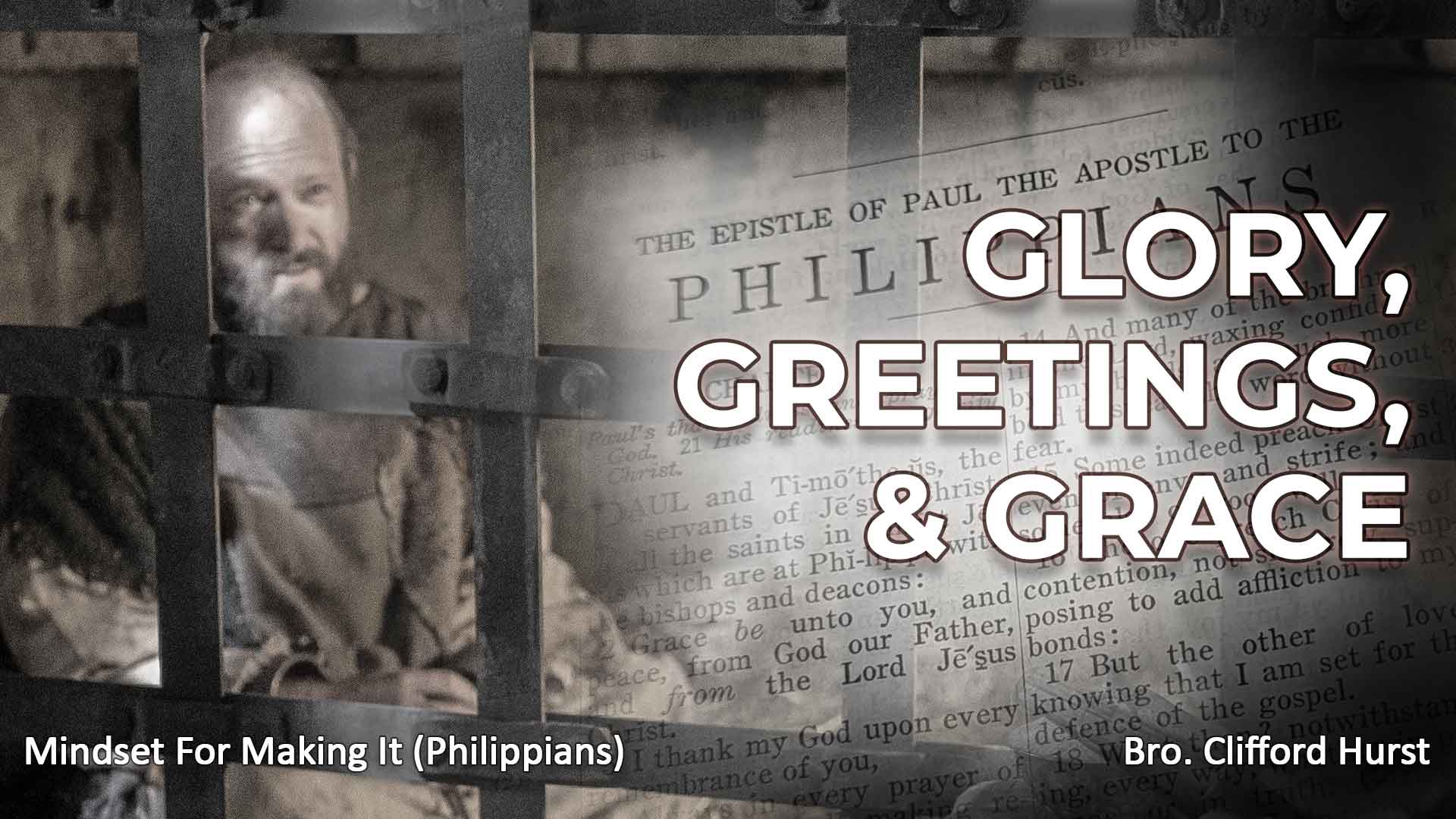
Glory, Greetings, And Grace

Apr 3, 2024
·Pastor Hurst
The Eclipse And The Day Of The Lord

Mar 31, 2024
·Pastor Hurst
Stoop, See, And Believe

Mar 31, 2024
·Pastor Hurst
Tears In The Morning, Peace That Night